


131 L / 200°C Max Thermal Abuse Test Chamber w/ Optional Automatic Extinguisher Fixture - MSK-TE909
131 L / 200°C Max Thermal Abuse Test Chamber w/ Optional Automatic Extinguisher Fixture - MSK-TE909
Minimum Order: $20 (equipment), $100 (crystals)
Shipping and handling will be applied
Price: RFQ
SKU:
Choose Your Variant or Type in Any Add-Ons:


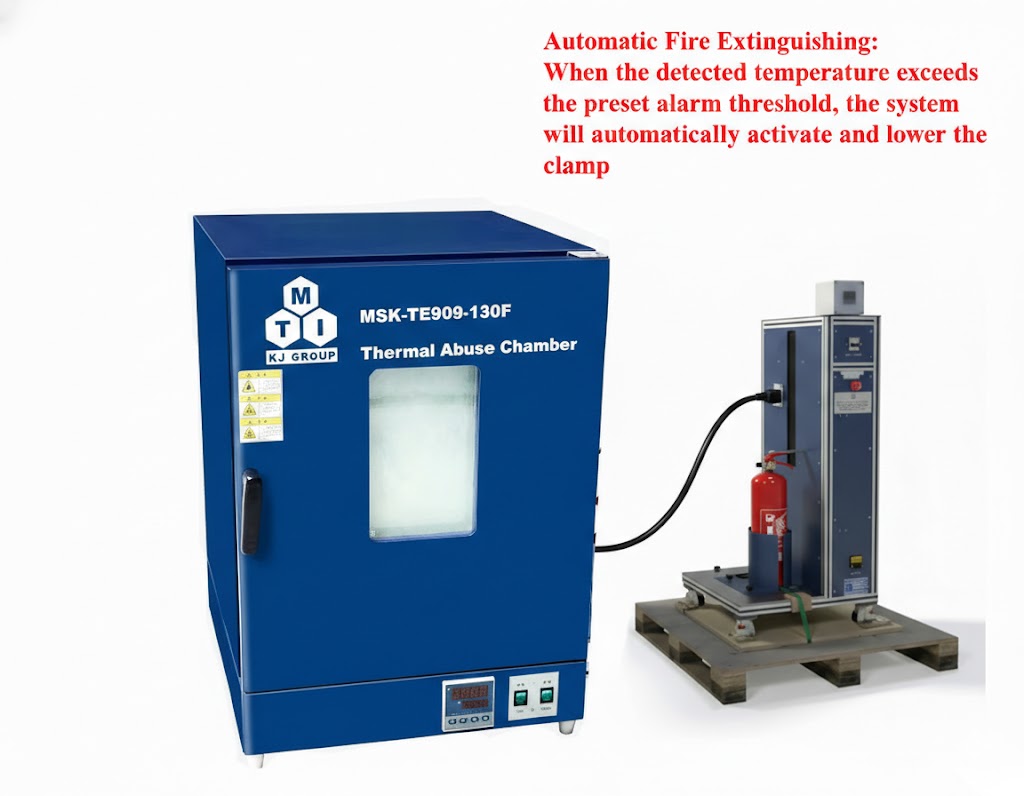
The MSK-TE909 Battery Thermal Abuse Test Chamber is designed for evaluating battery performance and safety under elevated-temperature conditions, with reference to IEC 62133, Section 8.2.2. The chamber provides programmable temperature control up to 200°C, with ±1 °C controller accuracy and ±2°C temperature uniformity in the working area. Its stainless steel interior, observation window, cable feedthrough ports, and pressure-relief opening support controlled battery thermal abuse testing.
The MSK-TE909 features a 131 L heated chamber, a 30-segment programmable digital temperature controller, over-temperature protection, and thermocouple failure alarms. Three optional fire-suppression configurations are available: automatic nitrogen gas discharge, an externally mounted automatic extinguisher fixture, or a combined system. Fire-suppression equipment must be selected and configured for the specific battery chemistry, energy capacity, and testing hazards.
SPECIFICATIONS
| Model | MSK-TE909 |
| Product Type | Battery Thermal Abuse Test Chamber |
| Test Standard Reference | IEC 62133, Section 8.2.2, as specified by the manufacturer. Confirm the applicable standard edition and test requirements before use. |
| Working Voltage | 208–240 VAC, 50/60 Hz, single-phase |
| Maximum Power | 2,200 W |
Heated Chamber
 |
|
| Working Environment |
|
| Maximum Heating Rate | 7 °C/min |
Temperature Controller
 |
|
| Chamber Temperature Range |
Room temperature +10°C to 200°C
Important: Place batteries and test samples on the supplied shelves during heating. Do not place samples or other objects directly on the chamber's bottom plate, as this may damage the equipment. 
|
| Access & Safety Ports |
|
| Optional Fire-Suppression Systems |
Three optional configurations are available at additional cost:
See the detailed options below for operating principles, equipment exclusions, and application limitations. |
| Recommended Battery Capacity for Testing |
Note: These are manufacturer-listed configurations, not universal safety limits. The appropriate configuration must be confirmed for the battery type, test conditions, and installed fire-suppression system. |
| Compliance |
|
| Features & Applications |
|
OPTIONAL FIRE-SUPPRESSION SYSTEMS
The MSK-TE909 can be equipped with one of three optional fire-suppression configurations. All fire-suppression fixtures are available at additional cost and must be matched to the intended battery test.
Option 1: Automatic Nitrogen Gas Suppression Fixture
 |
Safety note: Nitrogen discharge does not guarantee extinguishment of a lithium-ion battery thermal runaway event. Appropriate ventilation, oxygen-deficiency precautions, and an approved emergency response plan are required. |
Option 2: Separate Automatic Fire Extinguisher Fixture
 |
Important: Class D extinguishers are intended for certain combustible-metal fires and are not automatically suitable for all lithium-ion battery fires. Selection and integration should be reviewed by qualified fire-safety personnel. |
Option 3: Combined Nitrogen Gas & Automatic Extinguisher Fixture
 
|
The combined configuration does not eliminate the need for appropriate hazard assessment, chamber ventilation, and emergency procedures. |
RELATED PRODUCTS & EQUIPMENT
| Equipment | Description |
BST8-5A-CST Battery Analyzer
 |
Optional battery testing and analysis equipment, available at additional cost. |
BST8-4C10A50V Battery Analyzer
 |
Optional battery testing and analysis equipment, available at additional cost. |
OPERATING PRECAUTIONS
- Fire alarm configuration: The manufacturer specifies setting the high-temperature fire alarm threshold 2–3°C above the operating temperature setpoint. Verify this setting and the correct activation sequence against the supplied operating manual and fire-suppression equipment instructions before testing.
- Maximum temperature: The chamber has a maximum rated temperature of 200°C. Use additional caution when performing battery tests above 150°C.
- Sample placement: Always place batteries and other test samples on the removable steel racks. Do not place anything directly on the chamber bottom plate during heating.
- Emergency stop: For the optional separate extinguisher fixture, the source specifies keeping the emergency stop button released during normal operation and pressing it to stop extinguisher discharge. Confirm the exact control behavior and emergency procedure with the manufacturer before operation.
- Battery capacity: Confirm that the intended battery energy capacity is appropriate for the chamber and selected fire-suppression configuration.
- Fire-suppression limitations: Thermal runaway can generate flammable gases, high temperatures, and hazardous emissions. The optional suppression systems should not be treated as a guarantee of fire containment or extinguishment.
- Installation and operation: Use the chamber only in a suitable laboratory environment with an appropriate ventilation and emergency response plan. Follow the manufacturer's instructions and applicable battery testing safety requirements.